

how to find gross margin
What is the Gross Margin Ratio?
The Gross Margin Ratio, also known as the gross profit margin ratio, is a profitability ratio Profitability Ratios Profitability ratios are financial metrics used by analysts and investors to measure and evaluate the ability of a company to generate income (profit) relative to revenue, balance sheet assets, operating costs, and shareholders' equity during a specific period of time. They show how well a company utilizes its assets to produce profit that compares the gross margin of a company to its revenue Sales Revenue Sales revenue is the income received by a company from its sales of goods or the provision of services. In accounting, the terms "sales" and . It shows how much profit a company makes after paying off its Cost of Goods Sold Accounting Our Accounting guides and resources are self-study guides to learn accounting and finance at your own pace. Browse hundreds of guides and resources. (COGS).
The ratio indicates the percentage of each dollar of revenue that the company retains as gross profit.
For example, if the ratio is calculated to be 20%, that means for every dollar of revenue generated, $0.20 is retained while $0.80 is attributed to the cost of goods sold. The remaining amount can be used to pay off general and administrative expenses, interest expenses, debts, rent, overhead, etc.
Formula
Gross Margin Ratio = (Revenue – COGS) / Revenue

Example
Consider the income statement below:
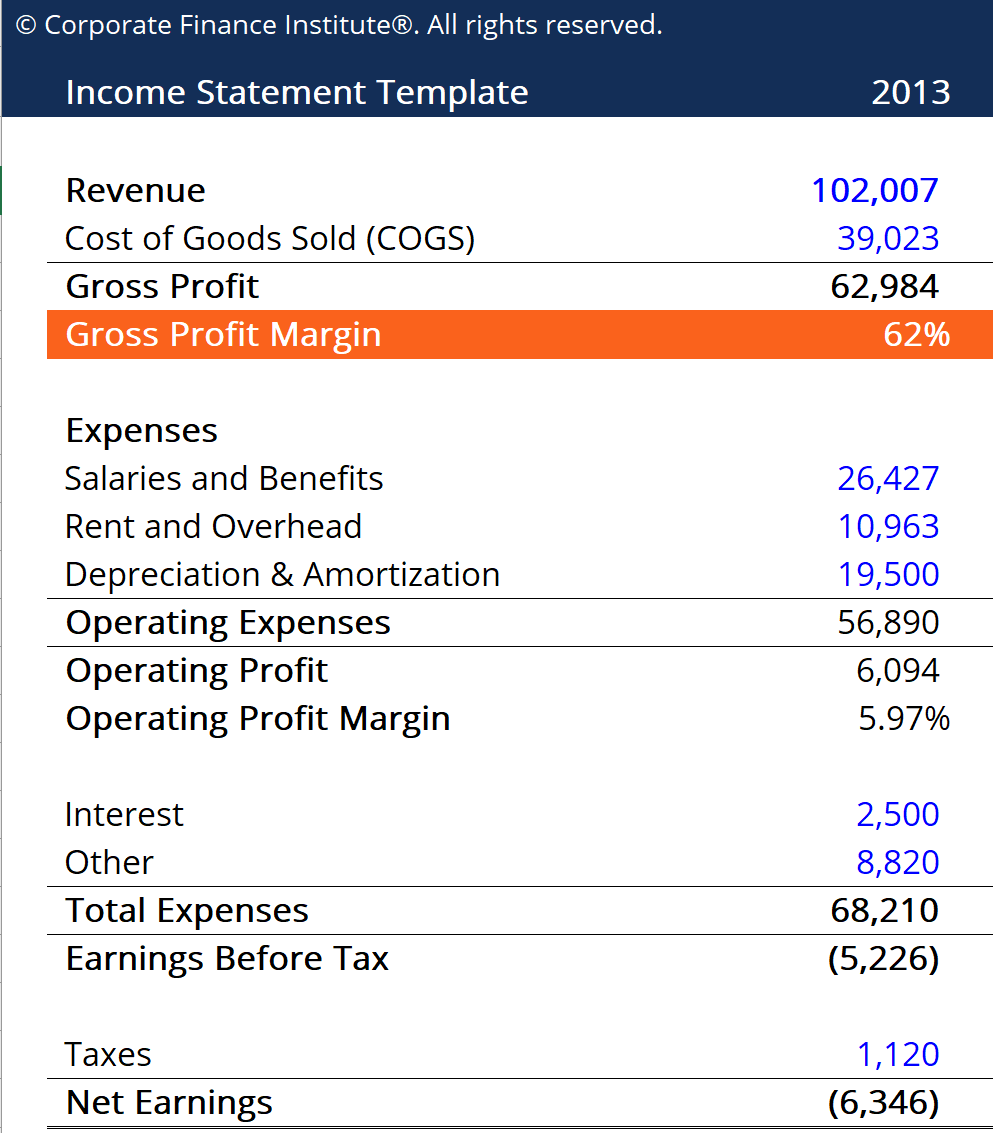
Using the formula, the gross margin ratio would be calculated as follows:
= (102,007 – 39,023) / 102,007
= 0.6174 (61.74%)
This means that for every dollar generated, $0.3826 would go into the cost of goods sold, while the remaining $0.6174 could be used to pay back expenses, taxes, etc.
How to Increase the Gross Margin Ratio
The ratio measures how profitably a company can sell its inventory. A higher ratio is more favorable. There are typically two ways to increase the figure:
1. Buy inventory at a cheaper price
If companies can get a large purchase discount when they purchase inventory or find a less expensive supplier, their ratio will become higher because the cost of goods sold will be lower.
2. Mark up goods
Marking up goods (selling goods at a higher price) would result in a higher ratio. However, this must be done competitively – otherwise, the goods would be too expensive and fewer customers would purchase from the company.
Download the Free Template
Enter your name and email in the form below and download the free template now!
Gross Margin Ratio
Download the free Excel template now to advance your finance knowledge!
The Gross Margin Ratio in Different Industries
A low gross margin ratio does not necessarily indicate a poorly performing company. It is important to compare ratios between companies in the same industry rather than comparing them across industries.
For example, a legal service company reports a high gross margin ratio because it operates in a service industry with low production costs. In contrast, the ratio will be lower for a car manufacturing company because of high production costs.
Consider the gross margin ratio for McDonald's at the end of 2016 was 41.4%. The ratio for the Bank of America Corporation at the end of 2016 was 97.8%. Comparing these two ratios will not provide any meaningful insight into how profitable McDonalds or the Bank of America Corporation is. But if we compare the ratios between McDonald's and Wendy's (two companies operating in the fast-food industry), then we can get an idea of which company enjoys the most cost-efficient production.
Gross profit margin is the first of the three major profitability ratios. The other two are operating profit margin, which indicates how operationally efficient a company's management is, and net profit margin, which reveals the company's bottom line profitability after subtracting all of its expenses, including taxes and interest payments.
There is a wide variety of profitability metrics that analysts and investors use to evaluate companies.
Additional Resources
Click on any of the CFI resources listed below to learn more about profit margins, revenues, and financial analysis.
- Net Profit Margin Formula Net Profit Margin Net Profit Margin (also known as "Profit Margin" or "Net Profit Margin Ratio") is a financial ratio used to calculate the percentage of profit a company produces from its total revenue. It measures the amount of net profit a company obtains per dollar of revenue gained.
- Cost of Goods Manufactured Cost of Goods Manufactured (COGM) Cost of Goods Manufactured (COGM) is a term used in managerial accounting that refers to a schedule or statement that shows the total
- Marginal Revenue Formula Marginal Revenue Marginal Revenue is the revenue that is gained from the sale of an additional unit. It is the revenue that a company can generate for each additional unit sold
- Net Income Net Income Net Income is a key line item, not only in the income statement, but in all three core financial statements. While it is arrived at through
how to find gross margin
Source: https://corporatefinanceinstitute.com/resources/knowledge/finance/gross-margin-ratio/
Posted by: martinezwithen1987.blogspot.com
0 Response to "how to find gross margin"
Post a Comment